Clicker Training for Horses
Clicker training is a practical, reward-based method that can help horses understand exactly which behaviours we would like them to repeat.
It can be used to teach new skills, improve everyday handling and create clearer communication between you and your horse. It can be incorporated into groundwork, routine care, hacking and ridden work, and is suitable for horses at many different stages of training.
However, successful clicker training involves more than simply clicking and handing over a treat. Your timing, choice of reward, food-delivery skills and understanding of how your individual horse learns all influence the outcome.
What Is Clicker Training?
A clicker is a small handheld device that produces a short, consistent sound. During training, the click identifies the precise moment your horse performs the desired behaviour. It tells them:
“Yes, that was the behaviour that earned the reward.”
The click is then followed by something the horse values, usually food, although scratching or access to a preferred activity may also be rewarding.
At first, the sound has no particular meaning. Through repeated pairing with a reward, the horse learns that the click predicts something positive. It becomes what we call a conditioned reinforcer or marker.
A short voice marker can also be used, such as “Yes”. I also like to use a tongue cluck, which can work in a similar way. The advantage of a clicker or a brief verbal marker is that the sound is distinctive, precise and consistent.
Why Timing Matters
Horses learn from the consequences that follow their behaviour. To communicate clearly, the marker must happen closely enough to the desired action for the horse to make the connection.
Imagine asking your horse to take one step backwards. They step back, move forwards again and then receive a treat. From your perspective, the food was a reward for stepping back. From the horse’s perspective, it may have reinforced stepping forwards, moving towards you or reaching for your hand.
A marker helps bridge the gap or delay between the correct behaviour and the delivery of the reward.
You can click at the exact moment your horse steps backwards and then calmly reach for the food. The click provides precise information, even when the reward takes another second or two to arrive.
Positive Reinforcement Encourages Participation
Clicker training is commonly based on positive reinforcement. Positive reinforcement means adding something the horse values after a behaviour, making that behaviour more likely to occur again.
For example, your horse stands quietly while you lift a hoof. You mark the response and provide a food reward. Standing calmly has produced a worthwhile outcome, so your horse is more likely to respond in the same way again.
This approach can encourage horses to take an active role in learning. Instead of only responding to avoid pressure or an unpleasant consequence, the horse learns that engaging with the training process leads to positive outcomes.
Choosing a Reward Your Horse Values
The trainer does not decide whether something is reinforcing. The horse does.
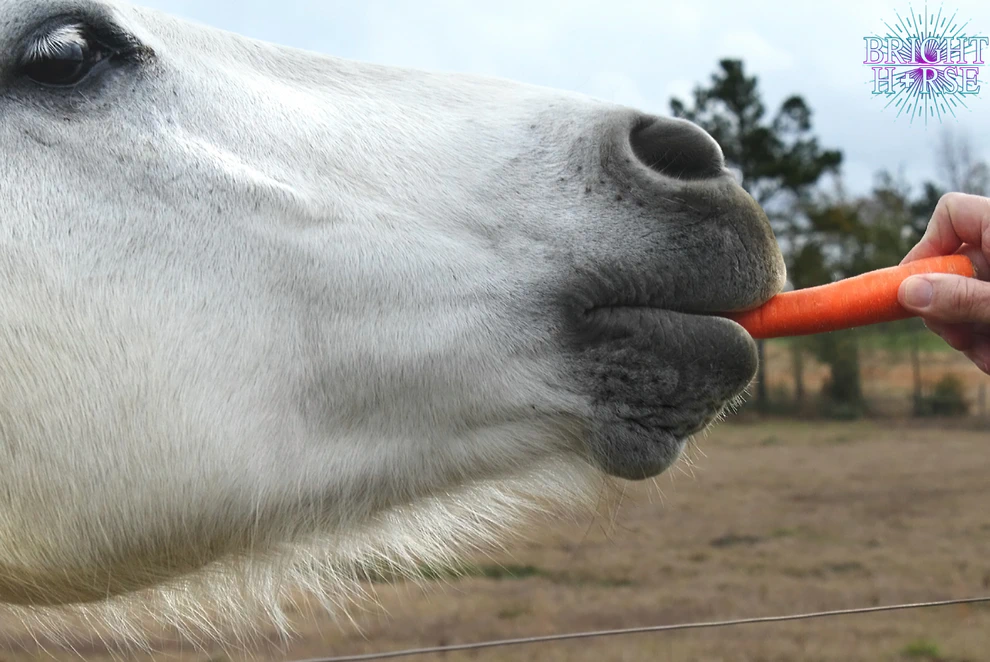
Many horses enjoy food, but preferences vary considerably. One horse may work happily for their usual feed or forage pellets, while another may be more motivated by small pieces of carrot, apple or a favourite horse treat.
Other horses may find scratching, grooming, access to forage, a pause in the exercise or another preferred activity rewarding.
The most effective reward will depend on:
- Your individual horse’s preferences
- The difficulty of the exercise
- The surrounding environment
- Your horse’s emotional and physical state
- The level of distraction present
- The horse’s previous experience with food rewards
A reward that works well during a quiet groundwork session may not be valuable enough when practising in a more distracting environment.
It is also important to consider arousal. A very high-value reward may motivate one horse while making another so excited that they struggle to concentrate or maintain an appropriate distance. Reward choice should support learning rather than overwhelm the horse.
Will Food Rewards Cause Biting or Mugging?
Using food does not automatically cause a horse to bite, nip, grab or mug the handler. Problems usually arise when food is delivered inconsistently or when unwanted behaviour accidentally produces the reward.
For example, a horse repeatedly pushes into the handler or searches their pockets. If the handler eventually gives them food, the horse may learn that persistence works.
Clear food-delivery skills can prevent this. The horse can be taught that calm behaviour, appropriate distance and keeping their head away from the handler are what make the food available.
A treat pouch can also create a useful boundary. It keeps rewards accessible to the handler while reducing fumbling and delays. When used consistently, putting the pouch on can become a signal that a structured training session is beginning.
The pouch should be positioned safely and out of the horse’s reach. Food should be delivered away from your body, with careful attention to your horse’s position and behaviour.
Will My Horse Only Respond When Food Is Present?
A well-designed training plan does not require you to show your horse food before every behaviour.
Food should usually appear after the response as reinforcement. When food is repeatedly shown in advance, it can become a prompt, meaning the horse may learn to respond only when they can see it.
During the early stages of learning, every correct response may be rewarded. This is called continuous reinforcement and helps the horse understand what is being taught.
Once the behaviour is well established, reinforcement can be varied gradually. Food may be used alongside scratching, rest, access to forage, movement or other rewards already present in everyday life.
Reducing food too quickly can weaken the behaviour. The aim is not to remove reinforcement entirely, but to create a practical and sustainable pattern of rewards.
Clicker Training Is Not Bribery
Food rewards are sometimes described as “bribery”, but this is not an accurate way to understand learning. Bribery is a human moral concept. Training is a process in which behaviour produces consequences.
It can be more helpful to think of the reward as payment for the horse’s effort. We routinely expect worthwhile outcomes for our own work, and horses are also more likely to repeat behaviours that lead to something they value.
The important distinction is when the food appears.
Showing food first to persuade a reluctant horse may function as a lure or prompt. Marking a completed behaviour and then producing the reward is reinforcement.
Clear Beginnings and Endings Reduce Confusion
Some horses become highly attentive whenever they think food may be available. They may follow the handler closely, search pockets, reach towards the treat pouch or repeatedly offer behaviours.
Creating a clear training context can help.
You might use:
- A particular treat pouch
- A designated training area
- A specific item of training clothing
- A consistent starting routine
- A clear marker
- An end-of-session cue such as “All done”
At the end of the session, remove the treat pouch and provide an appropriate transition, such as access to forage, a small food scatter in a safe area or time to relax.
This helps the horse understand that structured training has ended and that food is no longer available through the formal session.
What Can Clicker Training Be Used For?
Clicker training can support a wide range of practical skills, including:
- Leading and groundwork
- Standing calmly
- Backing up and moving away from light cues
- Lifting and holding up the feet
- Grooming and routine care
- Cooperative veterinary, dental and hoof-care handling
- Loading and travelling preparation
- Target training
- Building confidence around new objects and environments
- Hacking and activities outside the arena
- Ridden exercises and training under saddle
- Teaching tricks and enrichment activities
It may also form part of carefully planned behaviour-modification work. However, serious fear, anxiety, aggression, dangerous behaviour or a sudden change in behaviour should not be treated as a simple training issue.
Pain, discomfort and underlying medical concerns can influence behaviour. Horses experiencing significant behavioural difficulties may require veterinary input and an individual clinical behaviour assessment.
Start with Simple Foundations
Clicker training is most effective when both the horse and handler understand the process.
Begin with short, achievable sessions. Choose one simple behaviour, mark it clearly and deliver the reward safely. Observe your horse’s responses and adjust the training according to their confidence, motivation and level of understanding.
You do not need to teach complicated tricks to benefit from clicker training. The same principles can improve everyday handling, groundwork, hacking and ridden work while helping your horse understand what you are asking of them.
Start Clicker Training Your Horse
A FREE three-part guide to positive, reward-based horse training
Are you curious about clicker training but unsure where to begin? Clicker training can be a wonderful way to improve communication, encourage cooperation and make learning enjoyable for both you and your horse. However, getting the foundations right is important.
This FREE three-part guide will introduce you to clicker training gradually, with one practical PDF delivered to your inbox each week.
What You Will Receive
- Week 1: Getting Started: Learn the foundations of clicker training, what the click means and how to begin introducing positive reinforcement to your horse clearly and safely.
- Week 2: The Dos and Don’ts: Discover the common mistakes that can make clicker training confusing or frustrating. You will learn more about timing, rewards, safe food delivery and how to avoid accidentally reinforcing behaviours you do not want.
- Week 3: Practical Applications: Explore practical ways to use clicker training during everyday life with your horse, including handling, groundwork, routine care and other training activities.
The information is broken into manageable stages, so you will have time to read each guide, practise with your horse and build your skills gradually.