What is Bravery in equitation
“My horse is brave.” But what does that actually mean?
This is a really deep and complex topic, and it deserves a bit of scrutiny. Because when we talk about bravery in horses, from a behavioural perspective, it may not actually be the correct emotion for what the horse is experiencing in that moment.
And that’s where things start to get a little bit controversial within the equine industry. People who study behaviour often point out that bravery isn’t the right term. Horses don’t conceptualise courage the way humans do, but we are human and fallible, often placing that state on horses. Horses are responding to pressure, learning history/previous experiences, arousal, stress thresholds and training. That is the text book answer, but the more I’ve thought about it, the more I think we might be looking at this slightly the wrong way. Because bravery might not belong to the horse. Bravery might belong to the human. Does that mean it isn’t real?
To understand that, we need to acknowledge something that horse people often don’t say out loud enough: riding horses can be fucking scary, for both of us.
You are sitting on a 600kg animal with its own nervous system, its own reactions, its own survival instincts, a mind of it’s own. The risk of injury is real. Everyone in horses knows someone who’s broken bones, had concussions, or worse.
And yet modern horse riding isn’t just riding. It’s framed as sport. And with sport comes performance. And ego. And social validation within your community, a social pressure we cannot understate. Our human social structure plays a massive role in horse sports and equestrian pastimes. Our peer groups, our yards, our hunting fields, our competitions/shows, they all have ideas about what counts as a ‘good ride’, a ‘brave ride’, a ‘bold horse’.
That social context shapes how we experience the whole thing. Your social community*, might see jumping 1.2m as important, another might see you stopping a ride and letting the horse say ’no thank you’ as important. These social community’s are critical in how we see our relationships with our horses, but also the community within which we are part of.
If you, as the rider, feel that the task before you is daunting (a task that your community see as important for you to complete in order for you to belong) if you feel nervous, anxious, or honestly quite scared and then your horse goes and completes that task… a very powerful physiological state occurs, which creates psychological connections for you and that task.
You now belong. Because you: cleared the jump or ditch. Advocated for your horse and stopped. Or you made it around the course. Belonging is a powerful emotional state and suddenly the fear you felt gets transformed into relief, pride, excitement. Instead of saying “I was brave,” we often say: “My horse was brave.”
What we’re really doing is attaching our emotional experience to the animal who made that experience possible. And that creates a huge amount of love and admiration for the horse. It also creates compassion, gratitude and loyalty between the rider and their connection with that social community that allowed that emotion to take place. As you are now a member or have been accepted, you belong to it and as such are loyal to that community . Which is why this is actually really hard for people within that dyad to separate those emotions, when for example that community loses social licence to operate (SLO). We see this in horse racing, dresage, show jumping and hunting. When a scandle rocks the equestrian community, highlighting some less then ethical treatment of the horse, you as a member of that community have compassion, gratitude and loyalty with that social community. And can struggle to seperate those feelings from the practice that is no longer seen as acceptable. To do so would mean that you could not only lose that community, but also the positive emotional states created when you felt brave and love for your horse. Accepting that the practice may not be ideal is an uncomfortable place to sit and it means you must question your involvment.
When we look at the social communities around equitation, regardless of the ‘sport’ or ethics we attach to it, the same emotional dynamic exists in all of them.
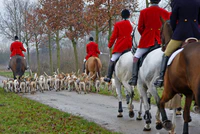
Currently in Ireland, fox hunting has or is rapidly losing its social licence to operate (SLO). There are three types of hunting that take place, where all communities will call ‘hunting’. A hunt can often just be a ‘fun ride’, a big social ride-out, without hounds, no hunting takes place, it is basically a XC ride/hack/trekking, where riders follow a ride leader (still called hunt master) over a predefined course. These often last about 1-1.5hrs.
A drag hunt, where a predefined course is set with scent for the hounds follow. Where again riders follow a predefined route with a rider leads in front. These can last 2-4 hours.
And then there is fox hunts, this is not predefined, the hunt master leads the way with the hounds. With the aim that the hounds will find and kill a fox. These can be all day events.
We still tend to call it all ‘hunting’, regardless of the type of activity. Which can be confusing for the general public.
Whatever form it takes, the atmosphere can be intense. You might have forty, sixty, sometimes a hundred horses out together. Horses get hot in that environment, which is a term used to describe a horse behaviour. It can look like ’excitement’, but is better defined as high arousal or reactive. As a rider, it can be a lot physically and mentally. And if it’s your first time out it can be genuinely intimidating.
- You’re worried about your horse. And your safety (but we aren’t allowed to talk about it…)
- You’re worried about how you’ll ride. (‘Can I actually do this?’)
- You’re worried about what other people will think. (because your community matters to you, it matters to us all)
Then the first big moment happens. The first obstacle (I’m not just talk about a fence/jump, but a mental barrier) you weren’t sure you were actually going to tackle. And you do it. Mine was the first time I towed my own horse to our first TREC POR competition, I pulled the trailer by myself to the location. It sounds small, but my heart was a jack hammer, I’d never been to a competition with my horse before and I had just learnt to pull a trailer.
When this happens, when you complete that first obstacle that had your heart racing, the people around you, your social community, your community, are cheering, shouting encouragement, celebrating that moment with you. Mine was my husband and friends, who knew how anxious I was. I had riders at my yard saying ‘Wow you towed that box all by yourself? and you went to a competition alone?!" I could hear and see that aww, and knew I felt brave, that my community also saw that and thought well of me, accepted me.
The emotional high from that is enormous, even writing my story above I can feel the emotion rising again. It’s a powerful drug when you feel supported, when you feel proud. You feel like you’ve proven something not just to yourself but to the people around you. And that feeling, knowing you were scared, and doing it anyway, that is bravery.
But instead of saying I was brave, we say: “My horse was brave.”
Because that moment of emotional validation came through the horse performing in that situation. And because we feel that emotional state so strongly, we often start to conflate it with what the horse must be feeling. We assume the horse felt the same courage that we did, it is easier to feel that even if it isn’t true. This is why I have compassion for the humans here. As a behaviourist I know in reality, the horse may simply have been responding to training, pressure, momentum, herd dynamics, or arousal.
But that doesn’t mean the word bravery is meaningless. Nor does it discount your emotions in that moment, they are real and valid. It just means we may have been assigning it to the wrong half of the partnership.
In other words ‘you were brave’, not necessarily your horse. And that can be very hard to parce.
People sometimes ask why behaviourists and horse people seem to talk past each other so often. And I’m actually not against using the phrase “My horse was brave.”. But I think there’s something important that needs to be acknowledged in that conversation. When riders say things like, “My horse was so brave,” they’re not usually trying to misrepresent the horse’s emotional state. They’re describing how they felt in that moment.
I’ve said it myself. Many times. I’ve turned around after something difficult and said, “I’m so proud of her. I’m so proud of my horse.”
But if I’m being completely honest about what’s going on inside my own head, what I really mean is:
- I’m proud of me.
- I’m proud that I did that.
- I’m proud that I overcame my fear.
Because bravery, in the human sense, belongs to the rider in that moment. It’s not actually the right emotion to project onto the horse. And I think part of why we do this, especially in Ireland, is cultural. We come from a place where openly owning our own emotions, especially positive ones about ourselves, can feel uncomfortable. There’s a long cultural thread, probably tied up with Catholic Ireland, where saying “I’m proud of myself” can feel a bit… egotistical. A bit too much.
So instead we move that emotion somewhere safer. We give it to the horse. We say the horse was brave, the horse was honest and we say we’re proud of the horse.
And in doing that, we avoid saying something that might feel self-centred. But actually, if we were able to be a little more honest about it, I think it would help both riders and horses. Because the best thing we could say in that moment might actually be something like this: “My horse was probably a bit scared there. That situation was a lot for them. So I’m going to go back and do some training and help them feel more confident.”
“And I’m also really proud that I overcame my fear and rode through it.”
That kind of statement is more accurate. It respects what the horse might actually have been feeling too. And it also gives the rider permission to acknowledge their own courage without shame. In the long run, I think that’s far more powerful. And I think it does both the horse and the human a lot more justice.
The Chickens Come Home To Roost.
Now, I want to move into something that sits right in the middle of this conversation. For those who don’t know, I have been actively involved in the ban on fox hunting in Ireland. But here’s the thing that sometimes surprises people.
- I am not against community, rural or equestrian pursuits (I actually work hard to support it).
- I am not against fun rides, hacks or trekking.
- I am not against people going out together on horseback and having those shared experiences.
I have been on what people would call a “hunt” myself (as defined above, it is a ‘fun ride’/trekking but colloquially we still call it hunting). There were no dogs and there was no fox hunting. Just horses. Riders. Community. And honestly, I think that is the natural evolution of this tradition. You remove the dogs. You remove the fox. But you keep the parts that people are actually emotionally attached to.
You can still have horses riding together, you can still have that electric atmosphere and you can still have the slightly chaotic energy of a big field of horses moving together. And yes, it is still scary. You still feel that knot in your stomach before the first jump. You still want to ride well. You still want to feel like you belong there.
No one is taking this feeling away from you, if this is what you want. And if this is you, when you do it, when you get around, when you jump the thing you thought you might not jump, you still get that same feeling.
The adrenaline rush. The cheering from your friends. The stories afterwards. The sense that you were brave enough to do the thing that scared you.
All of that is still there. If that is what you want And that’s important to understand when we talk about banning fox hunting.
Because the issue is not that people involved in hunting don’t understand the plight of the fox. It’s not that they’re incapable of recognising the stress that fast-paced events can put on horses. It’s not that they’re unaware of environmental concerns or land use or public opinion. People know all of that. Because people aren’t daft, humans can and do empathise. Horse people, especially, are deeply aware of what their animals go through. The level of care a horse requires is not an easy skill, understanding how to support them can take years to master.
Remember what we talked about earlier, that feeling of bravery. That moment where you were scared and you did it anyway, and your horse carried you through it. Before you send people who hunted to the sacrificial lamb remember the human psychology I spoke about. Humans find a deep and meaningnful connection with horses, that feeling creates a powerful emotional bond, beyond the event. As I said before it also creates compassion, gratitude and loyalty between the rider and their connection with that social community, as you now belong to that hunting community.
When riders talk about their horse being brave or courageous, they often say things like: “I’m so proud of my horse.” And on one level, yes, they are proud of the horse. But what rider’s are also saying, even if they don’t realise it, is: “I’m proud of what we did together.”
Because the connection between rider and horse in that moment is very real. Riders know, somewhere underneath it all, that their horse might have been stressed. That it wasn’t effortless, that the situation was big and noisy and fast. But riders also know that they were stressed too. And together, they got through it. That shared experience, that sense of ‘we did something hard together’, creates a level of affection and loyalty that runs very deep. And that part of human psychology cannot be understated if we are to have this conversation. (You can debate with me if it is right or wrong to put horses under this pressure, I’ll happily do it any time, but for this conversation we need to accept it is a reality and park that conversation for another day.)
When we try to talk about banning fox hunting purely through arguments; about ecosystem damage, or land management, or animal/equine welfare, or public opinion (SLO), we’re often missing the emotional core of the issue and not speaking to equestrians. We tell them they are terrible people without undestanding their emotions.
Remember it is very hard for people within that social community (fox hunting) to separate their emotions about that social group, because that social group accepted them and told them they belonged. As a member of that community you have compassion, gratitude and loyalty within that social community. And can struggle to seperate those feelings from the practice that is no longer acceptable by the public (also known as Social license to operate/SLO). To do so would mean that you could not only lose that community, but also the positive emotional states you created when you felt brave and love for your horse. Accepting that the practice may not be ideal anymore is an uncomfortable place to sit and it means you must question your involvment.
So we can say it till the cows come home that:
- Hunting is damaging to the ecosystem.
- Farmers aren’t happy about land being crossed.
- Horses can be pushed too hard.
- Foxes suffer.
- Dogs suffer.
If doesn’t matter at all if it’s true or not, it doesn’t matter how great public opinion is when you debate emotion. If these are the only conversations we have, we’re not actually listening to the human being who experienced that moment of bravery with their horse and feels that emotion. The rider who felt scared and did it anyway. The rider who felt their horse carry them through something difficult. The rider who felt their entire community cheering them on.
I was not suprised when the fox hunting bill in December 2025 did not pass, with 24 votes for and 124 against. Yet 72-79% of the Irish public want fox hunting banned. I was not suprised at all, though my friends were shocked when I said it would not pass. This is because the facts do not matter, not really, not when you vilify horse riders without understanding the human emotions and commmunity.
It is important to understand that for that social group we as the public suddenly tell them that they are bad people for feeling this way, remember it’s the emotional connection not the activity that makes them feel attacked. Because when we turn around and simply vilify those people, what we’re effectively saying is this:
- That moment of love and connection you felt with your horse? ‘You know you are are a monster, everyone here thinks it’
- That moment where you felt brave? ‘My mate told me you are a killer, how could you!’
- That moment where your community supported you? ‘You do know that we all hate you, right?’
If you felt joy in the past at this activity you are now a terrible person for enjoying the memory of that experience today. I have many memories of a horse I have loved deeply, that might not have been having the best time that I had in that moment. That is ok to still ennjoy those memories and say ‘Now I know better, and I’ll do better’.
Critically beating someone with that stick is not a conversation that changes minds.
If anything, it does the opposite, people will entrench deeper into their community and will refuse to hear anything from another opinion. It also fails our progression as a society, as we should be bringing everyone with us, not leaving people behind in their anger and mistrust. And for me, what is important is it misses opportunities to actually support horse welfare.
It pushes people further into their communities and further into defending those traditions. Because why would anyone willingly give up a memory that feels that powerful? Think about it in another context, your first holiday away from home after Covid? Imagine someone said to you ‘Omg you flew to ibiza for a stag do! Killing the planet much!”. And that person didn’t understand that that trip ment the world to you, because Covid ment you coudlnt’ see your best friends and didn’t have the wedding you wanted. It would hurt you.
In the same vain: Why would you walk away from something that made you feel brave, supported, connected to your horse and your friends?
Especially if someone is telling you that enjoying that moment makes you a bad person.
So if we actually want progress, if we genuinely want people to move away from hunting foxes with dogs (which I do) then we need to separate two things.
We need to separate the human emotional experience from the practice itself. This is very hard to do, if it was easy then we wouldn’t have these issues. Because the bravery people felt was real. The love for their horse was real. The connection to their community was real.
None of that needs to be denied.
But the practice of hunting a fox with hounds can still be questioned, challenged, and changed. And when we acknowledge the human side of it, instead of dismissing it, that’s when people actually start listening.
Make Change Happen
I write many things the push me further out of the my own social community. I use training techniques that just about pisses everyone off. If I use pressure and release (negative reinforcement), the force free (positive reinforcement) crowd hate me, if I use food rewards (positive reinforcement), traditional equestrians (negative reinforcement) hate me. I ride both with and without a bit, which manages to piss both sides off too. Even among my behavioural peer group if I don’t align on party lines, I piss everyone off.
This is really hard, and lonely, humans need a community. And if I’m honest, I’m scared every time I do this, it has gotten easier but it’s still scary. I get told things like ‘you are the only equestrian voice advocating for the horse in fox hunting’. I don’t see that as a good thing, it’s a very very bad thing. One is the loneliest number.
That is a really scary position to be in for a human, with no social community or support. I really don’t want to be… no one does, I dont want to be the ‘only one’, I want my community there. Because horse behaviour and welfare is my community. I know you are there, you will read this and think ’this is me but I am scared too’.
This whole pieces is about understanding bravery, and being accepted into a community for that bravery. Being scared of a thing a doing it anyway. So instead of seeing us all as seperate little dyads, that get annoyed at each other because ’that group does it differently’. It’s not bitless vs bitted, or barefoot vs shod, it’s horse and horse riders with no infrustruture or support in this country.
At the end of the day, what unites us is very simple: We love the horse. Our horse. All Horses.
That is the common ground. And when I look at the situation in Ireland, what I see are gaps. Huge gaps where the government has failed the equestrian community. Time and time again. Without hunting people have literally no where else to go. And I do not see the continued existence of hunting as a failure of the individuals who took part in it. I see it as a failure of the government to provide alternatives.
‘€79.3 million allocated for 2026 goes to Horse Racing Ireland (HRI) to support the industry, including prize money, infrastructure, and breeding.’
I provide that quote as we as members of the horse riding community should see that and our stomach should turn. While that money is allocated to one industry our goverenement fails to provide infrastructure to support horse riders. It is estamated that there are approximately 47,000 leisure riders in Ireland. Instead will allocate 79 million to gambling, an insidious addiction that does destroy communities (I will not address the welfare issues in horse racing here.)
We as equestrians, that 47,000, have little to no resources available to us. The money, our money as Irish citizens once again is given to the elite, keeping horse ownership as a gated community. When we talk about banning fox hunting the reason the community fears it, because it risks making horse riding only availble to those with means. As there is no real alternatives, places to ride your horse, unless you have your own land or have the money. This is because the government has failed to provide alternative for us. In the UK, for example, there has been a massive public push to create bridleways, safe routes where people can ride horses legally and safely across the countryside. At last count and I will double-check this at some point the UK has something like 140,000 miles of bridleways.
The UK is far more densely populated than Ireland. There are more people, more pressure on land, more urban areas. And yet they still managed to create an enormous network of public access routes for horses. That means that anyone regardless of means can ride their horse safely.
On those bridleways, riders can still do everything we talked about earlier.
- You can still go for a hack and feel a little bit brave.
- You can still train your horse.
- You can still ride with friends.
- You can still build those moments of connection with your community.
But in Ireland? You are lucky if you can safely hack down the road in your own local area. And that’s something I want the general public to really understand. Going out alone with a horse is not the same as going out for a walk with your dog. You are far more vulnerable. It can be genuinely scary. Four in five (85%) horse riders experienced an incident on the road. The BHS (UK) has reported 58 horses were killed on roads (last year), with over 3,100 incidents recorded. We have no statisitcs in Ireland, that I can find, we don’t even even track it in this country.
Riding on roads is for many, your only option, unless you have your own land or financial means (which again makes safe riding only available to the elite). Unlike walking your dog along, your horse doesn’t want to be alone on a hack. Horses are herd animals, they want to be with other horses. Being alone on a road then becomes even more dangerous, as horses are more likely to be on alert. But most horse riders don’t have much choice, except to hunt. Hunting takes you off the road, gives you access to places you don’t have access to most days and can make it safer being with other people.
And yet we are not setting horses or riders up to be safe within our communities. Why? But that solution requires government action. When I talk about banning fox hunting, I am not just asking for something to be removed.
I am asking for something better to be built.
I want the Irish government to start investing in bridleways and public access routes so that people can ride safely within their communities. It’s not that hard to do, especially if you’ll drop 79 million euro on horse racing. We need bridleways so that riders can go out together, that horses can be part of public life again and that equine tourism can flourish in a way that supports welfare, ecology, and local economies. And the sad reality is that we already have infrastructure in this country that could support this.
Ireland has an incredible canal system that runs across the country. Those canal routes were originally built for horses. Horses literally pulled the canal boats.
And now?
Horses are banned from those routes.
Instead, they have been turned into bicycle greenways. Tarmacked over, paved over, and called “green.” (dont get me started how you can call it ‘green when it is a tarmac path) I’m not even going to start that argument today… I will actually have as stroke…
But the obvious question is:
- Why are horses banned from the very paths that were built for them?
- Why are horses banned from so many forests?
- Why are we excluded from public access across the country?
Because if you remove hunting, but you also ban horses from everywhere else, then what exactly do you expect equestrians to do? This is why horse folks defend hunting like they do, becuase it is all we have… we aren’t welcome anywhere else…
Where are we supposed to go?
This is why my anger is directed where it should be directed. At the government. Because they have failed to provide infrastructure for a community that has been part of Irish culture for centuries.
I am angry that safe riding routes do not exist. I am angry that communities are forced into a system where hunting becomes the only place people can ride together safely. And I am also clear that I do not want fox hunting to continue.
Both of those things can be true at the same time.
And the responsibility for solving it sits firmly at the feet of the government.
The other agrument we have is equine tourism. What you might not know about fox hunting is that ireland has also built an entire system that relies heavily on hunting culture and tourism. People pay to come here, lease a horse (also known as a hireling) and essentially “ride it like they stole it.”. Right now, equitation and equine tourism in Ireland is something reserved for the elite. You can Google “irish hunting holiday ireland”, some are very transparent. Some you need to know where to look on social media. But here are a few package holidays, the season generally runs from 1st Aug to 31st Mar:
- Irish Red Fox Hunt, 1 day €574 (horse lease and accommodation not included)
- The Buddy Package (Fox and Hare/deer), 4 days €16,986, two hunts, accommodation, food and horse included
- Other packages range from €1,900 to €7,000
The other one you can do is “Lease a hunt horse/ lease a hireling”. A day hire, while direct daily prices for top-tier hunters can vary, specialised hunting experiences, including a suitable horse, can start around approx. €530 per day. Short-Term/Annual Leases are also a thing, leasing a horse for the full season, during my search I found a 15.1hh Connemara cross gelding experienced in fox hunting has been listed for a middle 4-figure amount for an annual lease.
As someone who is passionate about horse welfare, I find this very hard… The horse essentially becomes sports equipment, like renting a bicycle. But they are not machines, they are living breathing creatures who can and do suffer when rented out by someone who can just hand the animal back.
In contrast I also know people in Ireland who run incredible equine tourism facilities that are doing something very different.They take visitors/tourists, as well as local Irish people who have never been on a horse before or would like to learn, and they bring them out for quiet rides through the countryside.
Just walking or trotting, while Sightseeing or enjoying our beautiful country, enjoying nature and not destroying the ecology. Compared to hirelings, horses tend to have better welfare, as Horses are not being pushed to their limits. They’re not galloping across fragile land. They’re just walking and doing what horses actually do very well.
That kind of tourism supports local businesses and it supports Irish horses. It supports local communities. And it presents a far better image of Ireland to the world. However, the issue is that this is not a business that everyone can access, because there are not enough public access routies for horses. Those who have set up these centers own the land the use, they can and do (rightly) change people to access the space. Once again we are relying on those with means to provide facilities for the community. If any of these business decided to no longer provide this, then that resource would be lost. This is a story as old as time with Ireland, letting private companies/business dictate the narative and failing to provide public infrastructure.
But it doesn’t have to be this way.
There is a solution here, super simple on all fronts:
- We can maintain community in ireland.
- We can maintain social cohesion for small communities.
- We can support Irish horses and the ’land of the horses’.
- We can support tourism for our farmers and equine facilities.
I’m scared, help me be Brave
So I suppose the only way to end this is with a bit of honesty.
I’m scared. I’m scared whenever I share these thoughts. I’m scared about attending future events around fox hunting. I get scared because I feel like I am often asked to be a representative of the equine community, as people know I will stand up and be counted. And I will happily do that, not because it doesn’t frighten me but because I believe someone needs to stand up and say these things out loud.
Am I brave for doing it? I don’t know, I don’t think so, only that folks tell me I should feel that way. I don’t feel brave, I feel alone most of the time. I just feel like someone has to show up. Because without someone from the equestrian community standing there, speaking about horses and riders and the reality of what our lives actually look like, there won’t be anyone there to say it.
And that matters.
Because for a long time now, the equine community hasn’t really had a voice in these conversations about fox hunting. Or if we have, those voices have often been lobbyists (or idiots, lets be frank), people who make a lot of money from the system as it exists, people who treat horses more like sports equipment than the animals we actually live our lives with. Those are who ‘currently’ represent the equine community, and I do not think these people actually speak with our voice. They speak for their own interest.
And I know, from being part of this community, that most equestrians don’t want that. What we actually want is much simpler.
We want safe places to ride. We want community. We want to feel proud of our horses and proud of ourselves when we do something that scared us. We want those moments where our friends cheer us on, where we feel brave even though we were nervous five minutes earlier. We want to love our horses, take care of them properly, and spend time with them in a way that feels meaningful.
That’s what most horse people want.
And I think it’s time that those voices are part of the conversation.
So if anything I’ve written here resonates with you, whether you’re someone who hunted, someone who never hunted, someone who simply loves horses, or even someone who just cares about how we move forward as a country, then I would genuinely love for you to make your voice heard. I don’t care what side of the fence you’re on. Honest, good debate takes all views into account and this is an important conversation.
And until now, the equine community (the real people) haven’t really been present in it.
Maybe it’s time that changed.
And if I’m honest… maybe just showing up and speaking out, while you’re scared, is the closest thing to bravery there actually is.